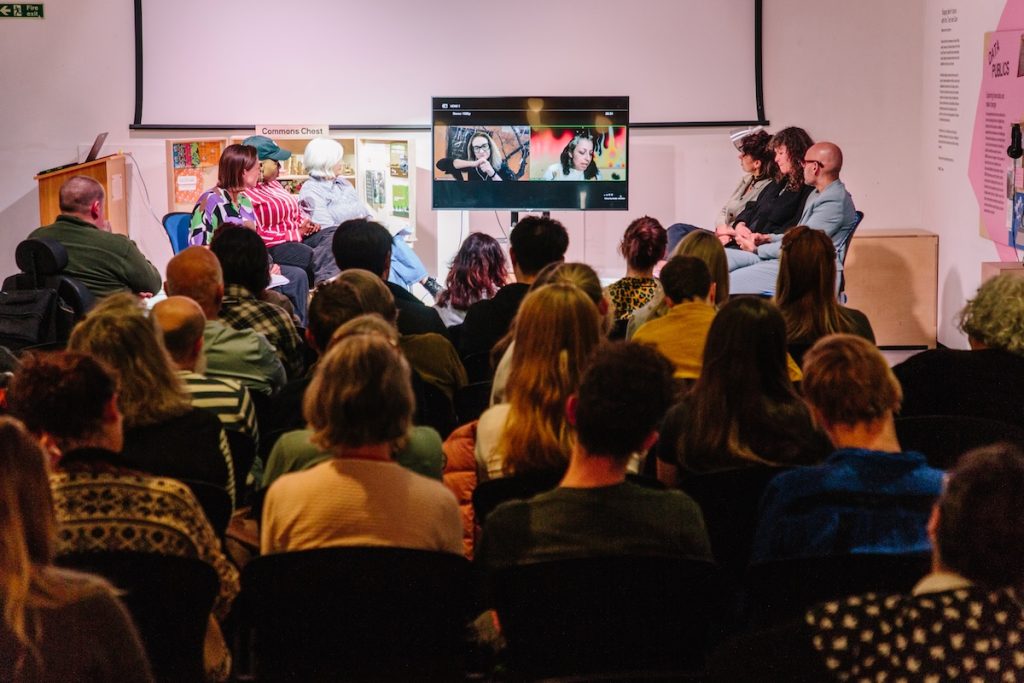
Whose Story Gets Heard & How Do We Tell It?
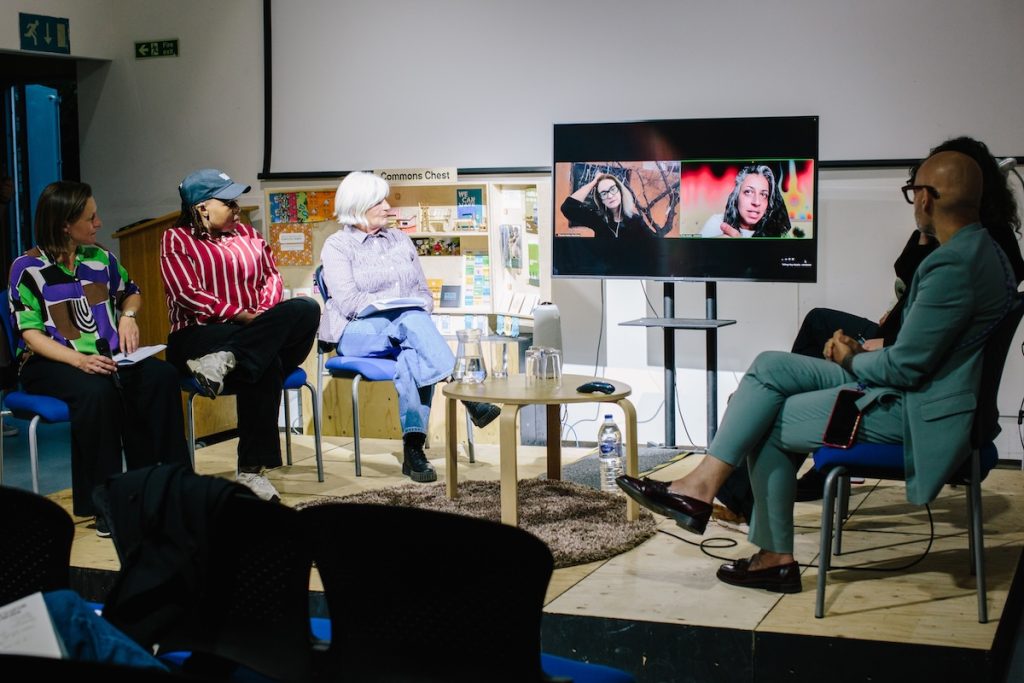
In April 2026, we gathered at Knowle West Media Centre (KWMC) surrounded by our Foundations for the Future exhibition to ask: ‘Whose Story Gets Heard and How Do We Tell It?’
In a world shaped by loud voices, corporate power, fake news and growing political division, this question feels more pressing than ever. More people than ever have access to tools to tell stories, but who is truly heard? And how can grassroots stories of hope and social action cut through the noise and drive real change?
This was the fourth and final event in our Foundations for the Future series, which has explored key strands of KWMC’s work over the past thirty years. KWMC’s journey began in the late 1990s as a community photography project. Since then, the technologies we use have changed, but the intention has stayed the same: for people to have access to the tools they need to tell their own stories and lead the change they want to see. So, this final event returned us to where KWMC began – with storytelling, or story-making!
The evening brought together storytellers, artists, organisers and filmmakers from Bristol and beyond:
- Joe Lambert: Co-Founder of StoryCenter in California, USA. On the night, Joe was represented by Brooke Hessler: a community arts activist, teaching scholar, and storyworker at StoryCenter.
- Isaac Samuels OBE: Co-Director at People’s Voice Media in London and national leader in disability and inclusion.
- Dr Mena Fombo: RTS-nominated documentary director and co-founder of Blak Wave, telling powerful stories with a focus on sport, women, and African diaspora communities.
- May Abdalla: Emmy-nominated director and co-founder of Anagram, creating award-winning immersive storytelling experiences with a social impact focus.
- Leila Gamaz & Hanna Kubuttat-Byrne: Collaborative artists connecting communities to Plymouth’s marine heritage.
Each speaker brought a different perspective, but together they formed what Brooke described as a “coalition of story workers”: people committed to shifting power through storytelling.
What emerged from the night wasn’t a single answer, but a set of provocations about power, care, ownership and possibility.
Stories as Resistance
The conversation opened with Brooke Hessler from StoryCenter. Over the past 30 years, StoryCenter have developed digital storytelling practices around the world – from early toolkits like the Digital Storytelling Cookbook to workshop models that influenced initiatives like the BBC Wales Digital Storytelling Unit.
Set against the backdrop of current US politics Joe and Brooke explored how powerful personal stories are because they are “ungovernable”.
“Personal stories are, in essence, ungovernable. They live in our bodies and our kitchens and our community halls. Increasingly, they are kept in personal archives and other formats that that can’t be so easily dismissed or erased.” – Brooke Hessler
Brooke highlighted how this matters more than ever right now as we witness attempts to reshape, suppress or rewrite public narratives. Funding structures, institutions, algorithms and media systems all play a role in determining what gets amplified and what disappears.
In a time of misinformation, censorship and political division, telling and holding these stories becomes an act of resistance. When shared collectively, stories become a counter-archive: a living body of knowledge that challenges official narratives and fills the gaps left by institutions.
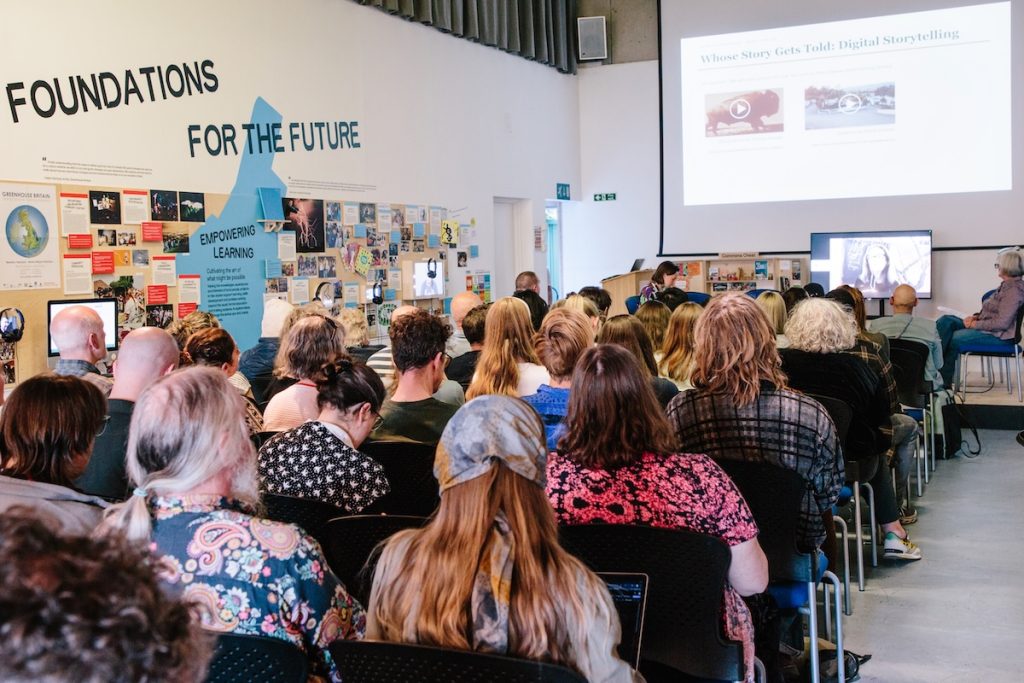
Who holds power in storytelling?
Who gets heard depends on who holds the power. Across the evening, the speakers returned to the same questions: Who gets to decide which stories matter? Who is seen as credible? Who controls the platforms, the funding, the distribution?
Isaac Samuels (People’s Voice Media) grounded this in the idea of ‘epistemic injustice’: the unequal value placed on different kinds of knowledge. Some knowledge – like academic or institutional – is privileged. Other knowledge – such as lived experience – is often dismissed, ignored or extracted without consent.
This creates what they described as:
- Testimonial injustice – when people’s voices aren’t believed or respected
- Hermeneutical injustice – when people don’t have the frameworks or recognition to make sense of their own experiences
For Isaac, storytelling isn’t neutral. It either reinforces power or challenges it.
At People’s Voice Media, this means designing processes where people aren’t just storytellers, but story shapers and knowledge builders. Stories are not extracted, they are instead collectively interpreted, shaped, and mobilised to influence change.
“Stories can only create change when people feel safe enough to tell the truth of their lives.” – Isaac Samuels OBE
Isaac also reflected that storytelling is not only being about being heard, but also about creating conditions where people feel emotionally safe enough to speak in the first place. Much of Isaac’s work is rooted in the belief that stories should never be extracted from people, but held with care, dignity, and accountability, particularly for communities who have historically been silenced, marginalised, or disbelieved.
Ownership and extraction of stories
Several of the speakers shared experiences of having stories taken, reframed or used without consent. This raises uncomfortable but necessary questions:
- Who benefits from a story being told?
- Who owns it once it’s shared?
- What happens after the story is told?
As StoryCenter’s principles emphasise, stories belong to the people who tell them, not the institutions that host them. This approach challenges extractive models often found in media, research and the arts. Instead of treating stories as content, it positions them as relationships that require care, consent and responsibility over time.
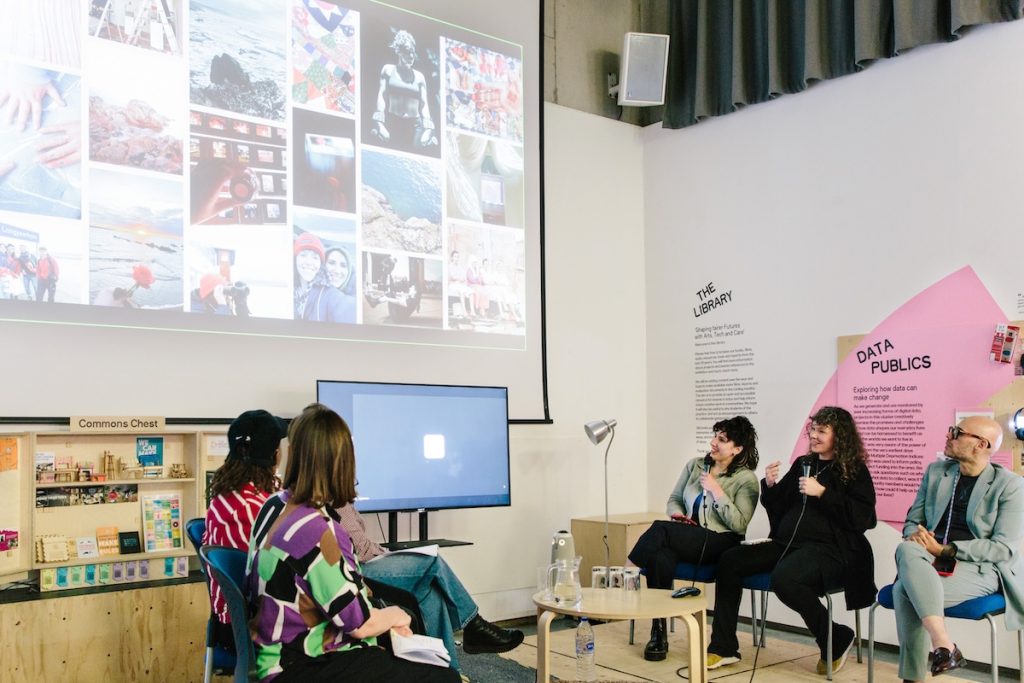
Leila Gamaz and Hanna Kubbutat-Byrne also brought this into their work on Tidekeepers, a co-created project exploring people’s relationship with the sea in Plymouth. They describe storytelling as a form of trust: something held collectively, not captured or controlled.
Leila and Hanna’s Co-Creation Framework centres storytelling as a relational, ongoing process, rather than a fixed outcome. Their work is grounded in care, non-extractive listening, ongoing consent, and shared authorship. They draw from radical education, decolonial practice, and community storytelling traditions. Participants are not “voices to be platformed”, but co-thinkers and co-authors, shaping ideas together rather than having stories extracted from them.
“ [We are] actively redistributing authorship and in the context of this project, that means not speaking for people. It’s people having the tools to tell their own stories.” – Hanna Kubuttat-Byrne
Focusing on process rather than outcome also allows their work to be non-linear. Their work remains open, becoming a living archive that continues to evolve in relationship with the people and places it comes from.
This challenges dominant models that prioritise speed, scale and deliverables over care, depth and relationship.
Their work also pushes us to think beyond human-centred narratives, asking how we can listen to and collaborate with not just people, but also to place, environment and the more-than-human world.
Read more about Leila and Hanna’s approach in their Co-Creation Framework.
Telling stories in systems that don’t hear you
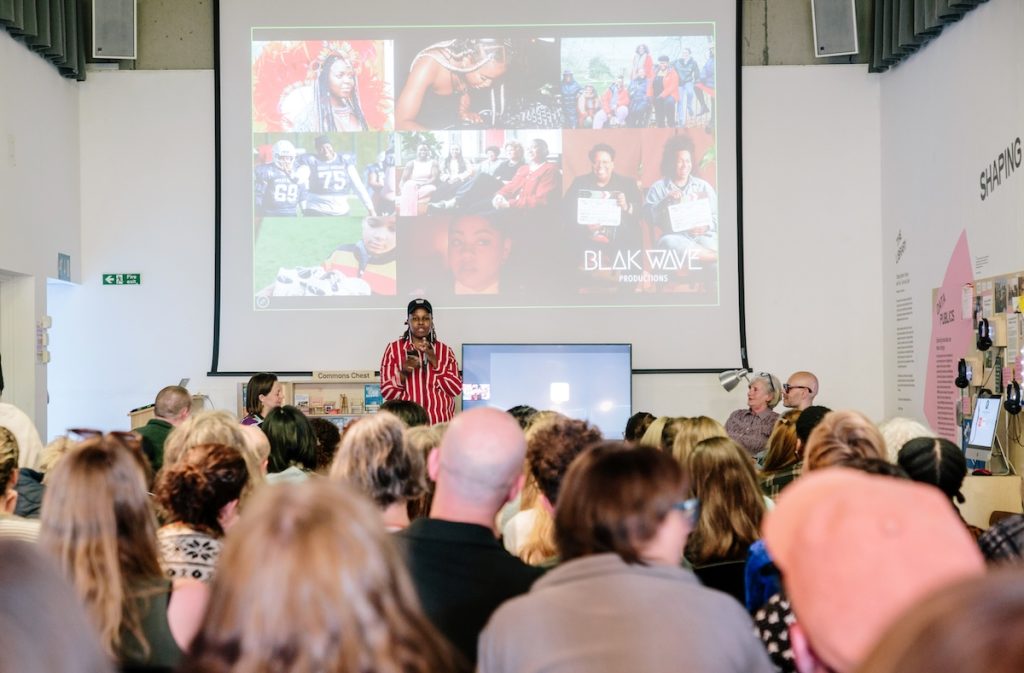
While much of the evening focused on grassroots and community-led storytelling, filmmaker Dr Mena Fombo (Blak Wave Productions) offered insight into what happens when stories enter mainstream systems like TV and film.
In broadcast media, decisions about what gets funded and seen often come down to commissioners, funding bodies, and perceived ‘market value’.
Stories about Black, queer or marginalised communities are frequently labelled as “niche”, narrowing their perceived audience and increasing the risk for those funding them.
Mena responded by co-founding a production company to tell stories on her own terms and creating pathways for others to do the same. She highlighted the persistent deeper structural factors shaping storytelling:
- Access to resources and funding
- Networks and relationships
- Time, stability and support systems
Or, as she framed it through Maslow’s hierarchy of needs:
“It’s hard to tell stories when your survival needs aren’t met.” – Dr Mena Fombo
At the same time, she reminded us that storytelling doesn’t stop where institutions say it does. Across the world, people are creating, sharing and circulating stories outside traditional systems – even if those stories aren’t always recognised by dominant platforms in the West.
“I stopped caring about trying to convince other people that hold certain power that our stories are worth telling because there’s a global audience. So being black and female might feel like a niche topic here, but in Nigeria, there’s 128 million black women that might resonate with some my stories.” – Dr Mena Fombo
As well as this, Mena emphasised the importance of timing and how it can shape which stories are given space. Her recent film about Black female rugby players, often labelled as “niche”, was supported because it coincided with the Women’s World Cup in the UK and a growing mainstream interest in women’s sport. She also highlighted something just as important: the power of being seen. Seeing your own experiences reflected on screen, and knowing that your story matters, shifts who gets to feel recognised, valued and heard.
New forms, same questions
While many speakers shared similar values, they also brought very different forms of storytelling – from quilts as living archives to documentaries to immersive VR encounters.
May Abdalla (Anagram) explored how emerging technologies like virtual and augmented reality can create new forms of embodied storytelling. Her work asks: What happens when you don’t just watch a story but feel like you’re inside it? How does that change empathy, understanding and memory?
Interestingly, research suggests that immersive experiences can be remembered by the brain as if they actually happened, blurring the line between story and lived experience.
“There was always a barrier between the person watching the film and the people in the film […] What if you’re in the same place? One of the interesting kind of qualities of VR […] is that you are genuinely in a place. And if you’re in a place, you have a vulnerability.” – May Abdalla
But May was clear that technology alone isn’t the answer.
For May, stories aren’t just something we read or watch – they’re something we feel. The body is the technology. Our bodies already hold memory, emotion and response. This reframes storytelling as something we experience and encounter, not just consume. Meaning is felt as much as it is understood. So digital tools are most powerful when they extend the human experience, rather than replacing it – creating encounters that are immersive, embodied and harder to ignore.
Storytelling in troubled times
Across all contributions, there was a shared recognition that we are living in a time of political division, misinformation, and inequality of voice/access.
In this context, storytelling is not a neutral act. It can be used to divide, but it can also be used to connect, to resist, and to reimagine.
Brooke spoke to the urgency of this moment, describing how – in the USA, UK and beyond – we are seeing “a systematic attempt to erase many of our stories.” In response, storytelling becomes a way to build counter-archives, holding lived experiences that challenge dominant narratives.
Isaac reminded us that this work is rooted in justice. Stories are knowledge, shaped by power. And how we listen matters as much as how we speak:
“Listen to hear, not to respond.” – Isaac Samuels OBE
Mena highlighted the structural barriers that still shape whose stories are heard, particularly in media industries where power remains concentrated. In this context, telling your own story is itself an act of resistance.
May brought a focus on experience and embodiment, asking what it means not just to see stories, but to feel them. How might that shift understanding and empathy in an increasingly disconnected world?
Leila and Hanna framed storytelling in “troubled times” as a practice of holding multiple truths at once, like a tapestry made from many threads.
Across these perspectives, one thing became clear: this work is not easy. It involves:
- Sitting with discomfort
- Navigating power dynamics
- Holding care for ourselves and others
- Letting go of control
But it also holds possibility: for connection, for change, and for imagining different futures together.
What next?
Throughout the night, it became clear that there is no single right way to tell stories. However, there are shared commitments that can guide us:
- Centre first-person voice
- Respect ownership and consent
- Actively challenge power and inequity
- Prioritise care and relationships
- Create space for multiple forms and formats
- Build and protect community archives
Joe and Brooke described stories as infrastructure: the connective tissue of culture. If storytelling is infrastructure, then it shapes what kind of world we are building.
Stories are not neutral. They carry power and they shape whose futures are possible.
At KWMC, this means continuing to ask hard questions of our own practice:
- Whose stories are being told and who is still missing?
- What power do we hold and how are we using it?
- Are our storytelling tools and approaches still fit for this moment?
- What care, skills and processes are needed to facilitate storytelling today?
Continue the conversation
This work doesn’t end here.
We’ll be continuing these conversations through workshops, partnerships and future projects – building spaces where stories can be shared, challenged and held with care.
If you want to stay part of it, sign up to our mailing list and follow us on Instagram, Facebook, BlueSky and LinkedIn.
We’re always open to new collaborations. If you have an idea or proposal, get in touch: enquiries@kwmc.org.uk.
Special thanks to our photographer, Ibi Feher.
Resources
- Isaac’s talk slides and workshop slides
- Hanna and Leila’s Co-Creation Framework
- Joe and Brooke’s StoryCenter slides
- StoryCenter’s Digital Storytelling Cookbook