‘Garden Lab Whispers Grow’ (2023) explored how new sensor technology can be combined with local, embodied and non-human knowledge to further climate action. After several workshops and collaborative experiments, we ended up creating new prototypes for mud battery beds, robot snail cameras, and accessible macroscopes!
Our team of collaborators included KWMC producers, Wales-based DIY tech artist Paul Granjon, accessibility advocate/disabled designer Ruth Hennell, local green groups, and local disabled creatives Oliver Woods and Daisy Hvnter. Below is a short film summarising the whole project:
Mud Batteries
Mud batteries capture the electricity produced by microbes living in the soil. They are a great way of making people aware of the life going on under their feet at all times. This time, we began with potting some humble weeds – often disregarded by gardeners as a nuisance. However, even a weed can create power with a little help…
To make the mud battery, we planted the weeds in pots of soil. Then, some copper and zinc-plated electrodes were added to the pot, creating a chemical reaction which produces electricity. Bacteria in the soil settle on the electrodes, bringing more power to the battery. The weed in the pot helps keeping the soil healthy and nutritious for the microbes. This reaction generated enough power to turn on a small LED light. Here’s a video of artist Paul Granjon explaining how make one yourself:
However, the power created by the mud battery was low and it faded when too much was required from the microbes. To allow the microbes to “rest”, we powered the circuit at regular intervals instead. We tried linking multiple batteries together, creating a harvesting circuit that stores the electricity from the microbes until there is enough to flash a little red LED light. We learned that while one plant pot can create about 0.5 volts, five plants joined together can create around 2-3 volts.
This voltage can be represented through sound. We experimented again with a speaker (powered by a separate standard battery) which generated sound depending on the voltage reading. The sound was a quiet crackly noise when the voltage was low and got louder when the voltage was higher. This crackle can be re-coded to any sound, so one volt could be a chicken clucking, while two volts is a cow mooing!
Mud Battery Prototyping
We loved that the microbes cannot continually create electricity – they need to rest, as we all do, particularly those of us with chronic illnesses. Inspired by this, Ruth made a prototype for a plant bed in the shape of a human bed. We imagined having the batteries activated by a timer switch which played a little melody for a few minutes before the microbes rested again.
They look like a wotsit with little wiggly tails!
Oliver, co-creator
Meanwhile, Oliver created a 3D-printed case for the mud battery’s circuit board to sit inside. The design was based on photos of soil microbes, which “look like a wotsit with little wiggly tails”!


Macroscope Prototyping
Alongside our mud batteries, we also played with macroscope cameras (not to be confused with a microscope, which captures atoms and molecules. Instead, a macroscope captures extreme close-ups of anything that could be seen with the naked eye).
We explored the idea of creating a mobility aid with it, adding a joystick control at the top. This would enable people with mobility disabilities to view different perspectives without necessarily moving their physical bodies. Paul hacked a Nintendo Wii remote to control a WiFi macroscope…


Meanwhile, Ruth had been thinking of a snail-shaped case for the macroscope, inspired by the ‘snails eye view’ she gets when she lies down on her mat. She loved the idea of sending out a robotic snail out to explore on her behalf when she is stuck in her flat with fatigue or pain. We prototyped this further at The Factory using a toy remote-controlled car!
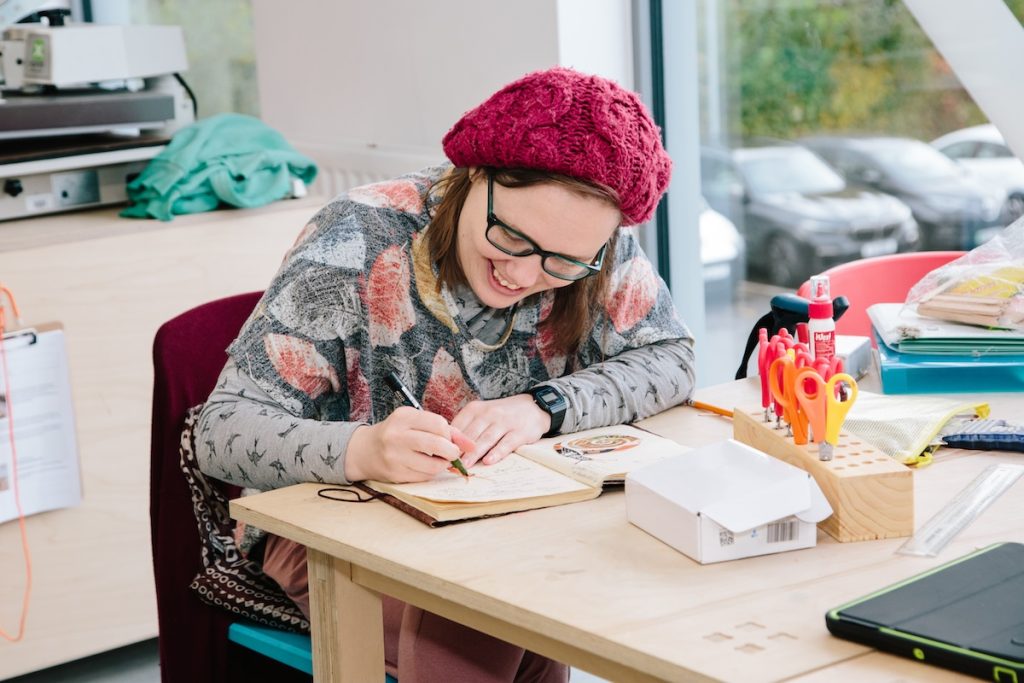

We celebrated our findings in an exhibition at Knowle West Media Centre in November 2023. We encouraged everyone to use this space as a ‘living laboratory’, inviting people to add their ideas, get hands-on with our prototypes, and create their own mud batteries:

Daisy Hvnter created three digital collages capturing the story of the project. Each of these artworks were UV printed onto chipboard over at KWMC The Factory, then featured in the exhibition:


Special thanks:
Huge thank you to everyone who has supported these projects over the past several months: Impetus, local gardeners/green spaces, change makers, artists, ecologists, Knowle West Alliance and as always, the people of Knowle West.
Special thanks to Bristol + Bath Creative R+D for funding Garden Lab Whispers Grow through Grounding Technologies, which supported six projects to investigate how creative tech might support climate action. Check out all the other inspiring Grounding Technologies projects here.
This project ran alongside Collect to Connect which similarly explored nature connectedness in Knowle West’s green spaces as well as how to make green spaces more accessible for humans and other-than-humans (living creatures, plants, organisms). Read more about Collect to Connect here.
This project is supporting KWMC’s aims for setting up future long-term citizen science programmes in the neighbourhood. We are excited to continue this work through future projects, all driving towards our goal of creating thriving neighbourhoods and thriving green spaces through arts, tech and care.
